
Free, instant, no sign-up
AC Size Calculator for Florida Homes
This AC size calculator for Florida homes gives your tonnage and BTU in seconds. Drag the slider or type your square footage, and the estimate updates as you go.
Want the exact number? We do a free in-home load calculation before any install.
How many tons of AC per square foot in Florida?
This calculator starts at 25 BTU per square foot, which works out to roughly one ton for every 480 square feet. The rule of thumb you will find on national sites is 20 BTU, and it is too low here. Our systems fight sustained heat and a heavy latent humidity load at the same time, and a unit sized to a Midwest rule of thumb spends a Florida August losing.
From that baseline the calculator adjusts for ceiling height, the age of the building and its insulation, sun exposure, how much glass you have, whether the windows are impact or low-E, how many people live there, whether the kitchen is in the cooled space, and whether ductwork runs through a hot attic.
One ton equals 12,000 BTU per hour, so a 3 ton system moves 36,000 BTU an hour. Nothing about it weighs three tons.
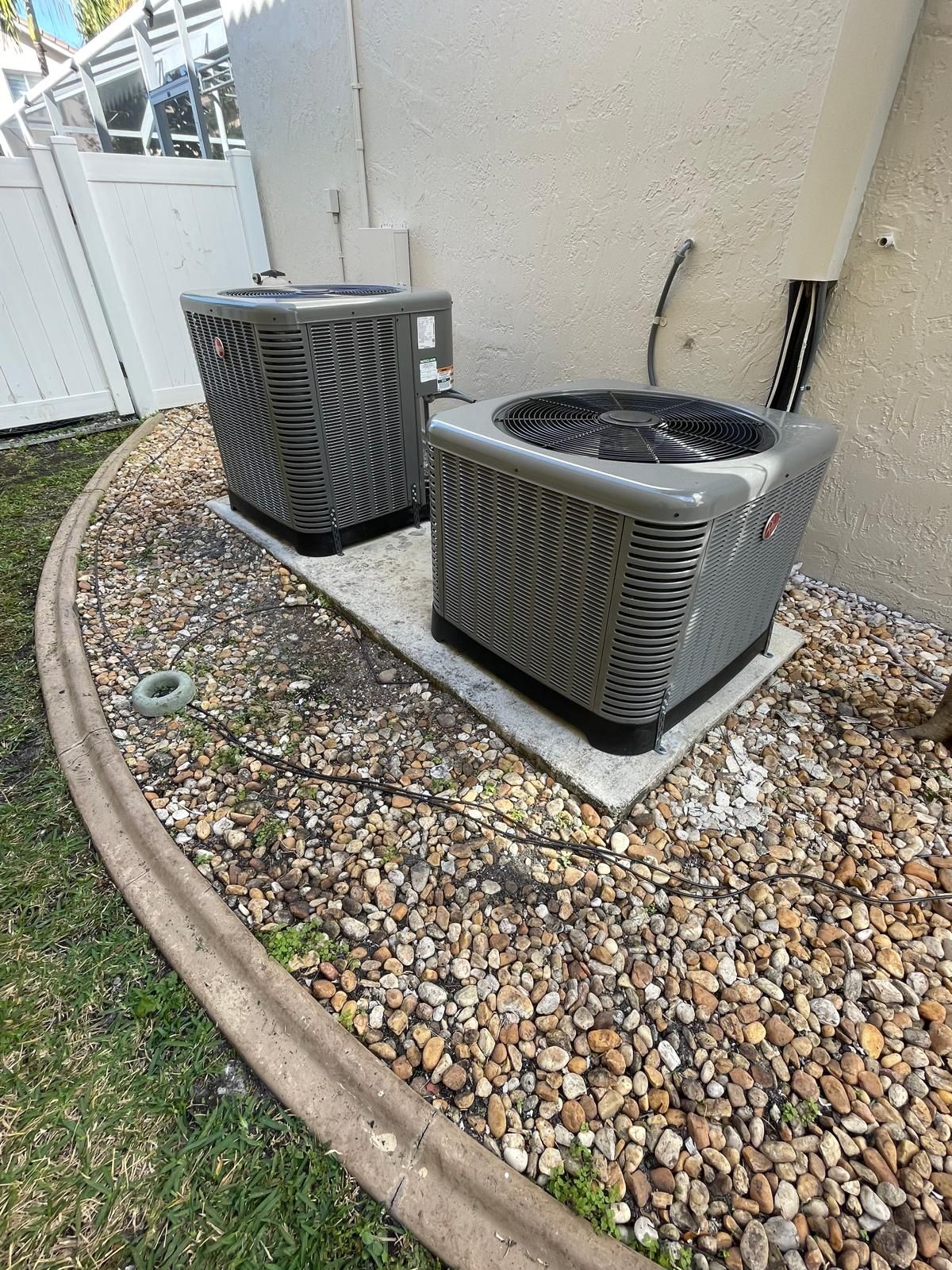
Quick reference: square footage to tons
Average Florida construction, standard ceilings, nothing unusual. Your own number can land a half ton either side of this once the rest is accounted for.
| Home size | Estimated BTU | Unit size |
|---|---|---|
| 600 sq ft | 15,000 BTU | 1.5 tons |
| 800 sq ft | 20,000 BTU | 2 tons |
| 1,000 sq ft | 25,000 BTU | 2.5 tons |
| 1,200 sq ft | 30,000 BTU | 2.5 tons |
| 1,400 sq ft | 35,000 BTU | 3 tons |
| 1,500 sq ft | 37,500 BTU | 3.5 tons |
| 1,600 sq ft | 40,000 BTU | 3.5 tons |
| 1,800 sq ft | 45,000 BTU | 4 tons |
| 2,000 sq ft | 50,000 BTU | 5 tons |
| 2,200 sq ft | 55,000 BTU | 5 tons |
| 2,400 sq ft | 60,000 BTU | 5 tons |
Note the jump at 2,000 sq ft. That works out to 4.17 tons, and 4.5 ton units are not manufactured, so it rounds to 5. That is precisely the case where a real load calculation is worth doing, because the right answer may be a 4 ton system with better ductwork rather than a bigger box.
Why a bigger AC is not better in Florida humidity
An oversized unit cools the air fast and then shuts off. That sounds good and it is the single most common sizing mistake we are called out to fix. Short run times never give the system long enough to pull the moisture out, so the house ends up cold and clammy instead of comfortable.
In Florida, humidity is half the job. A correctly sized unit runs longer and steadier, dries the air as it cools, holds an even temperature room to room, and costs less to run because it is not slamming on and off all day. It also lasts longer, since most of the wear on a system happens at start-up.
What this estimate cannot see
Square footage is a starting point, not an answer. A proper ACCA Manual J load calculation measures the things this form has to assume: your actual insulation values, duct layout and duct leakage, window orientation and shading, infiltration, and how the house is really used. Two homes of identical size on the same street can need different systems.
Next Level Air Conditioning does that calculation free before any installation. If you are weighing a replacement, the AC replacement page covers what the job involves, and AC installation covers a new system end to end. If the space has no ductwork at all, a ductless mini-split is sized differently again.
Common questions about AC sizing
How many tons of AC do I need per square foot?
In South Florida, plan on roughly 25 BTU per square foot, which is about one ton for every 480 square feet. The national rule of thumb is 20 BTU, and it is too low here because our systems fight sustained heat and heavy humidity at the same time. Ceiling height, sun exposure, glass and insulation all move the number from there.
Is it better to oversize an air conditioner?
No, and it is the most common sizing mistake we are called out to fix. An oversized unit cools the air quickly and shuts off before it has run long enough to pull moisture out, so the house ends up cold and clammy. It also short-cycles, which wears the equipment at the point where most of the wear happens, at start-up.
What is a Manual J load calculation?
It is the industry standard method for sizing a system properly. Rather than working from square footage alone, it measures your actual construction, insulation, duct layout, window orientation and air leakage. Next Level Air Conditioning provides one free before any installation.
Does a bigger AC cool a house faster?
It reaches the thermostat setting faster, which is not the same as cooling the house. Temperature is only half the job in Florida. A correctly sized system runs longer and steadier, dries the air while it cools, and holds an even temperature from room to room.
Get your free load calculation
Send us a few details and we will call you back to set up your free estimate. Or call now.
Prefer to talk? Call (561) 839-7199. Or call our secondary line, (954) 687-7199. Email info@nextlevelairconditioning.com.
Open 24 hours, 7 days. Regular hours Mon to Fri 8 AM to 6 PM, Sat 8 AM to 12 PM. Outside those hours it is emergency service at an after-hours rate, and we tell you that rate before we dispatch.